OPERA FUTURES
Founded by Mary Finsterer

Opera Futures is an initiative supporting the creation and future life of major new works.                                 It serves as a creative engine room, bringing together the artistic and professional resources required to take     ambitious projects from conception to the stage and beyond, into an enduring life in the repertoire.
Sydney Opera House. 2011 Dean Golja
At the heart of Opera Futures is a commitment to artistic excellence, historical inquiry, spirituality and storytelling. Through sustained research, development and collaboration, ambitious new works are brought from conception to the stage.
The current major project is JOAN OF ARC, an 80-minute oratorio by composer Mary Finsterer and librettist Tom Wright, commissioned by the MELBOURNE SYMPHONY ORCHESTRA. Written for five solo voices, narrator, SATB and boys’ choirs, organ and full orchestra, and published by Schott Music, the work will receive its world premiere with the Melbourne Symphony Orchestra at Hamer Hall in October 2027.
Through Opera Futures, philanthropic support is being raised to advance Joan of Arc during this pivotal period of artistic development. This will contribute to artist fees, professional music engraving and the preparation of performance materials for publication, audio and video recording, editing and post-production for artistic documentation, and special VIP Artistic Previews — essential steps in bringing a work of this scale from manuscript to stage.
Following its first performances, Joan of Arc is conceived with an enduring life in view: publication, future productions and international engagement. It embodies the broader vision of Opera Futures: to create ambitious new works that reach across time, speak to the present and resonate far beyond their premieres.
Support for Joan of Arc can be made through the OPERA FUTURES | JOAN OF ARC campaign with the Australian Cultural Fund.
About JOAN OF ARC
Music by Mary Finsterer
Libretto by Tom Wright
Published by Schott Music
World Premiere:
21 October 2027, Hamer Hall
Tickets → Melbourne Symphony Orchestra
Featuring:
Melbourne Symphony Orchestra
Benjamin Northey, conductor
Joseph Nolan, organ
Trinity College Choir Melbourne
Australian Boys Choir
Mia Chenea Robinson, Joan of Arc
Alex Ritter, Archangel Gabriel
Timothy Reynolds, Archangel Michael
Emilia Bertolini, St Catherine
Stephanie Dillon, St Margaret
Narrator, TBA
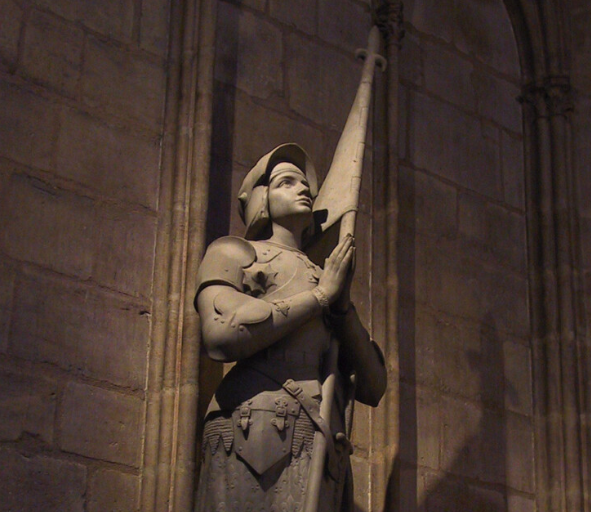
“I am not afraid… I was born to do this.” — Joan of Arc
Overview
Joan of Arc is an 80-minute oratorio by Mary Finsterer and Tom Wright. Following their critically acclaimed and sold-out operas Biographica, Antarctica and The Rising World, and Finsterer’s award-winning Stabat Mater, this new work draws inspiration from Joan’s visions, her trial testimony, and the enduring power of her legacy.
Narrative Structure
Scored for narrator, five solo voices, adult choir, boys’ choir, organ and full orchestra, the piece frames Joan’s story through a contemporary devotee who guides the audience—part narrator, part questioner—yearning for a world in which the material and supernatural realms speak to each other.
Story
Joan, a peasant girl whose visions propelled her into battle, became a symbol of both spiritual and political resistance. Betrayed and condemned as a heretic, she was burned in Rouen—yet her heart remained intact, a potent relic of devotion and mystery.
Musical Language
The musical language of Joan of Arc extends Finsterer’s signature interplay of spoken and sung voices, blurring the boundaries between drama and oratorio. The narrator’s text is woven through a vivid contrapuntal fabric of solo, choral, and orchestral writing. Musical influences range from the radiant simplicity of medieval chant and Renaissance polyphony to the colour and power of twentieth and twenty-first-century techniques, filtered through Finsterer’s distinctive voice.
Each saintly presence—Michael, Catherine, and Margaret—is characterised through contrasting musical identities, embodying faith militant, purity, and devotion. Joan’s voice emerges as both fragile and radiant, charged with the tension between earthly suffering and spiritual transcendence.
The orchestra spans from monumental climaxes to transparent intimacy, evoking the battlefield, the trial, the vision of a cleansed kingdom, to the glimpse of eternity in her cell, her ordeal at the hands of her enemies, and the mystic journey of her heart.
Production Aesthetic
As an oratorio, Joan of Arc adopts a restrained production aesthetic, relying on lighting and projections rather than traditional sets. Its visual world is shaped through iconographic imagery—light, colour, and symbolic motifs—evoking the otherworldly and psychological realms Joan inhabits.
Contemporary Resonance
In this piece, Joan is a deeply contemporary voice, as well as a voice which transcends time. She is the seeming outsider – poor, despised, ‘mad’ – who is actually driven by courage and independence of thought. She is the voice of resistance to power, of creativity, and inspiration, coming up against oppressive, worldly machines. This aspect – Joan as a site of resistance – gives the oratorio a strikingly in-the-zeitgeist feel.